Technical guide · Digital engineering
Nuclear digital twins: from data to decisions
A useful digital twin is not just an animated 3D reactor. It is a documented combination of physical-system data, models, assumptions, uncertainty and software controls that can be tested against real evidence.
Independent background guide · Reviewed 22 November 2026 · For education, not nuclear design approval.
What makes a model a digital twin?
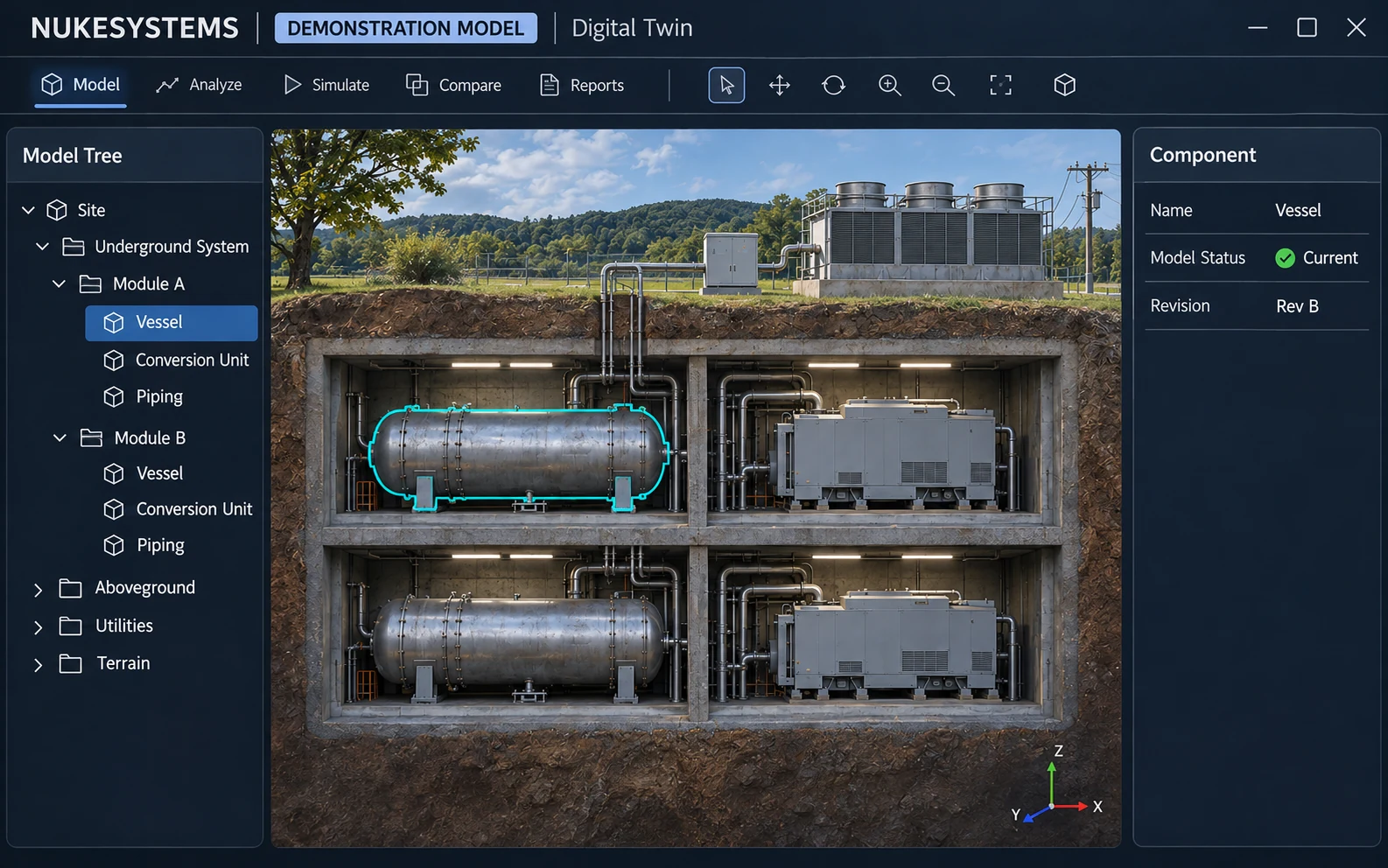
An engineering model represents selected physical processes. A digital twin connects relevant observations from a real system to one or more models, with explicit rules for updating state, checking accuracy and recording changes. Without measured data or a verified physical counterpart, the most accurate description is a digital engineering model or prototype twin environment.
The data layer
Sensors, historian records, calibration histories, equipment identifiers and operating context must be associated with each observation. Missing data, drift, changing units and timestamp mismatch can make a sophisticated dashboard misleading. NukeData studies these information-management problems; no live NukeSystems nuclear telemetry deployment is claimed.
The modeling layer
Different questions require different approaches. Neutron transport calculations, thermal-fluid analysis, structures, reliability and operations can be handled by separate validated tools. OpenMC and MOOSE are examples of openly documented technologies, but naming them on this site does not establish completed NukeSystems calculations or acceptance by a regulator.
Verification, validation and uncertainty
Verification asks whether software correctly solves the intended mathematical problem. Validation asks whether its representation is sufficiently accurate for the intended physical use. Both need test cases, traceable inputs, qualified personnel, uncertainty analysis and change control. Model outputs must never be presented as physical measurements.
Safety boundaries and security
A visualization or analytics service should not silently become a safety-critical controller. Access control, signed software updates, network segmentation and an independently justified safety architecture are essential topics for any future deployment. The responsibilities of a digital twin, plant monitoring system and licensed protection system must remain distinct.
What NukeTwin is today
NukeTwin is an early-stage NukeSystems research direction for digital modeling and engineering evidence. The present website shows conceptual user interfaces and proposed workflows, not a commissioned twin or a real reactor connected to the cloud.
Independent technical references
These sources are independent background material, not evidence of affiliation, endorsement or validation of NukeSystems.
- Digital engineering to advance nuclear energy deploymentIdaho National Laboratory (INL) · reference
- Evaluated Nuclear Data File (ENDF) libraryNational Nuclear Data Center, Brookhaven National Laboratory (NNDC/BNL) · reference
- OpenMC Monte Carlo neutron and photon transport code — documentationOpenMC development community (originated at MIT) · reference
- MOOSE — Multiphysics Object-Oriented Simulation EnvironmentIdaho National Laboratory (INL) · reference
Listing a publication or tool does not imply collaboration, endorsement or use in a completed study. See Engineering & Sources.
Frequently asked questions
Can a twin replace physical reactor tests?
No. Simulations can support development and planning, but model credibility depends on verification and validation with appropriate physical evidence.
Does a dashboard prove the reactor works?
No. A dashboard can display demonstration data or model output without any physical reactor being connected.
Are OpenMC and MOOSE used by NukeSystems?
They are documented external tools under consideration; actual use would require a reproducible study record and published scope.
Continue exploring
Discuss a research question
We welcome written technical questions and collaboration inquiries.