Exploratory research
NukeHome™
A long-range study of whether a professionally operated, separately sited energy facility could support a residential district or remote community.
Why study community energy
Housing developments and remote communities require reliable electricity, heating, backup capacity and safe delivery networks. Some locations face constraints on grid expansion.
NukeHome explores the energy-service problem at community scale. It does not propose placing a reactor inside an individual residence or bypassing nuclear siting and licensing rules.
How the research relates to NukeSystems
Any future proposal would require an independently engineered power source, licensed siting, physical protection, distribution, emergency planning and qualified operators. NukeSystems digital monitoring and site modelling are potential non-safety-related research components only.
Research scope / preliminary targets — no verified performance
- Concept scope
- District or remote-community energy
- Historical study envelope
- 20–500 kW electrical; not assessed for feasibility
- Illustrative demand
- 1–100 homes; not a design commitment
- Siting
- Separated, professionally operated facility; no residential reactor
- Development stage
- Exploratory research only
Technical study · 01
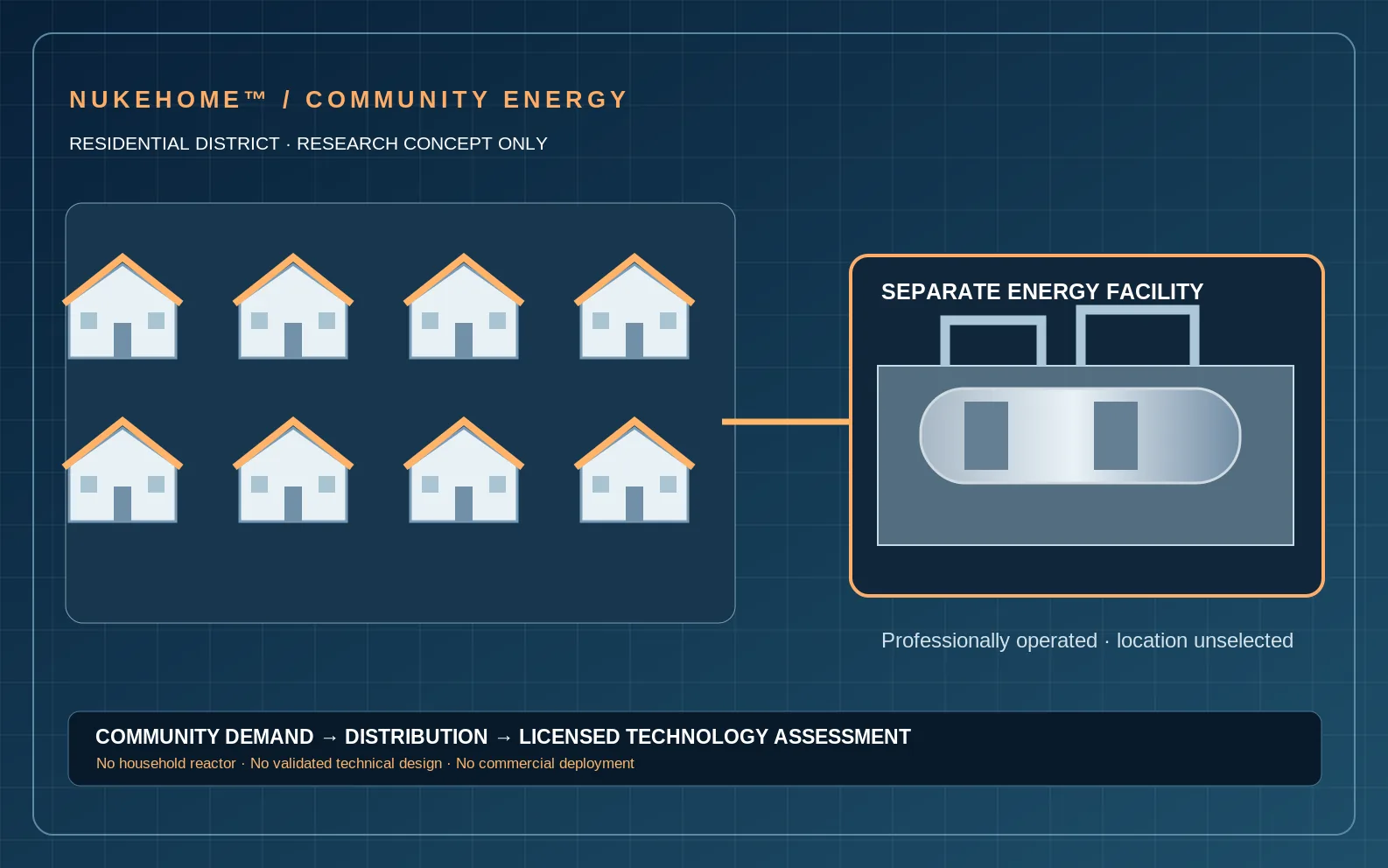
The concept, made visible
This original drawing explains the proposed system at a glance. It is a research illustration, not a scale drawing or verified design.

Intended functions
What a feasibility study would examine
Functions the system is intended to provide. Implementation and verification status require separate confirmation.
Demand model
Electricity, seasonal heat and peak household loads at community scale.
Technology choice
Compare grid expansion, renewables, storage and regulated nuclear options before any selection.
Site separation
Land, emergency planning, physical security and qualified operations outside residences.
Safety case
Radiological protection, shielding, waste, decommissioning and public acceptance.
Power distribution
Redundant feeders, metering and grid interoperability.
Cost and impact
Realistic delivered electricity cost, schedules and alternatives.
Status
What is defined and what needs verification
Defined now
- Name and purpose as a future community-energy research direction
- Historical power range is an unvalidated exploration target
- No proposal for in-home nuclear hardware
Requires verification
- Whether any proposed nuclear scale is technically or economically suitable
- Siting, staffing, emergency planning, grid and licensing obligations
- Cooling, shielding and waste management
- Economics relative to conventional technologies
- Availability of a qualified technology partner
Related material
Independent sources and related pages
- Advanced Reactors Information System (ARIS) and SMR catalogue 2026International Atomic Energy Agency (IAEA) · reference
- 10 CFR Part 53 — Risk-Informed, Technology-Inclusive Regulatory FrameworkU.S. Nuclear Regulatory Commission (NRC) · reference
- Power Reactor Information System (PRIS)International Atomic Energy Agency (IAEA) · reference
Listing a publication or tool does not imply collaboration, endorsement or use in a completed study. See Engineering & Sources.
Browse all project drawings and engineering studies →
- NukeReactor™Energy · Main project
FAQ
Questions
Is NukeHome a nuclear reactor inside a house?
No. This is a research concept for community-scale energy services, not a home appliance or a residential reactor.
Can a community buy NukeHome today?
No. There is no product, demonstration, approved design, deployment programme or committed price.
Are the previously discussed kW numbers validated?
No. The 20–500 kW envelope is a historical brainstorming range and has not passed engineering or economic feasibility review.
Research community energy systems
We welcome written technical input on distributed energy, public safety, siting and alternative technologies.